Lucilius Press › Reading guides
Heraclitus' fragments, explained
Heraclitus wrote one book around 500 BC, and it is lost. What survives are roughly a hundred and thirty short quotations, the fragments, preserved by later writers who quoted him. They keep returning to a few ideas: there is one shared order in things, the Logos, that most people sleep through; everything changes, like fire; and opposites belong together.
The main ideas, briefly
The Logos. His opening words say there is an account of how things are, common to everyone, and that most people fail to grasp it even after hearing it.
Fire and change. The world is like an ever-living fire, kindling and going out in measures. Things keep turning into one another.
The river. His most famous image. It is less a claim that nothing lasts than a claim that some things stay the same by changing. We have a separate page on the river.
Opposites. The road up and the road down are one and the same. Sickness makes health sweet. Tension holds the bow and the lyre together.
Why they read like riddles
The fragments are short on purpose and often cut off from their context, because we only have the lines other writers chose to quote. The numbers you see, like B1 or B12, come from the standard collection by Diels and Kranz.
English editions
Charles H. Kahn's The Art and Thought of Heraclitus (Cambridge, 1979) gives each fragment with a long commentary. Brooks Haxton's Fragments (Viking, 2001; later a Penguin Classics paperback) is a short, poetic version with the Greek facing.
The Lucilius Press edition of Heraclitus' Fragments is a modern plain-English translation. It arranges the fragments by theme with a short introduction to each group, and adds the ancient life of Heraclitus, a glossary and an essay on how he has been misread. Here is how the book's first group opens.
B1. Of this Logos, which holds always, people turn out unable to understand, both before they have heard it and when they have heard it the first time. For though all things come to pass according to this Logos, they are like men with no experience of it, even when they meet with such words and deeds as I set out, dividing each thing according to its nature and telling how it stands. But the rest of mankind are unaware of what they do awake, just as they forget what they do asleep. (via Sextus Empiricus)
B2. Therefore one must follow what is common. [The quoting author, Sextus, adds a gloss here explaining Heraclitus’s Ionic word for “common.”] Yet though the Logos is common, the many live as though their thinking were their own.
B50. Listening not to me but to the Logos, it is wise to agree that all things are one. (via Hippolytus)
From Heraclitus' Fragments, translated by Owen Halloway, Lucilius Press. Fragments B1, B2 and B50. Free sample, reproduced from the book.
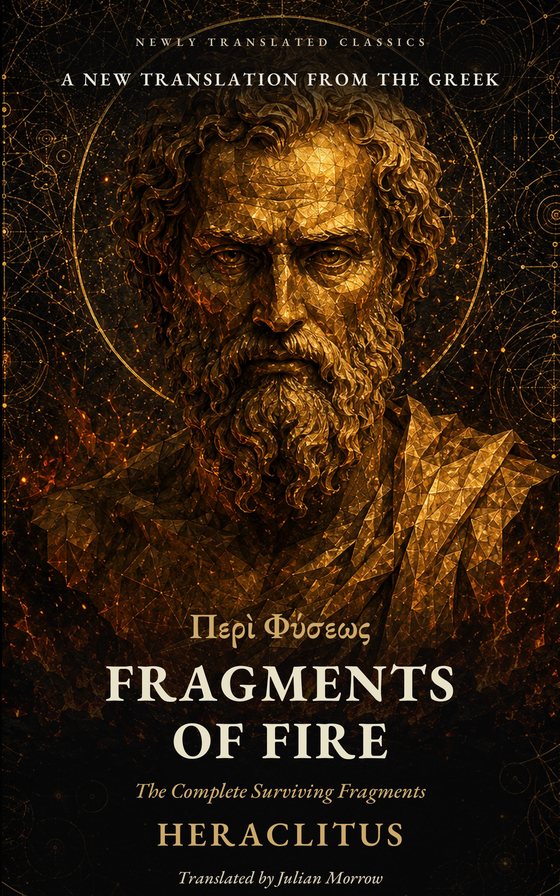
Heraclitus' Fragments
Translated by Owen Halloway