Lucilius Press › Reading guides
What survives of Zeno of Citium's writings?
None of Zeno's books survive. He wrote a Republic and works on ethics, nature and logic, but we only know them through titles, short quotations and reports by later writers, above all Diogenes Laertius' life of Zeno in Book Seven of his Lives. The same is true of the next two heads of the school, Cleanthes and Chrysippus.
Where the pieces come from
Diogenes Laertius gives Zeno's life, a list of his books, a stock of his sayings and a long summary of early Stoic teaching. Other writers such as Cicero, Plutarch, Seneca and Sextus Empiricus quote or report bits more. In the early 1900s the scholar Hans von Arnim gathered the Greek and Latin fragments of the early Stoics into a collection for specialists.
For English readers, The Stoics Reader, translated by Brad Inwood and Lloyd P. Gerson (Hackett, 2008), is a teaching selection.
What the Lucilius Press edition gathers
The Early Stoics: Zeno, Cleanthes and Chrysippus is a modern plain-English collection. It has a translation of Diogenes Laertius Book Seven, as far as that book survives, an essay on each of the three founders with a short list of their sayings drawn from Diogenes, Cleanthes' Hymn to Zeus, and a glossary. The book says plainly that it cannot restore what is lost, and keeps the ancient writers' "they say" hedges. Here are three of Zeno's sayings.
When his cargo was lost in the shipwreck that brought him to philosophy, he said, “Now I have had a good voyage, now that I have been shipwrecked.” (Diogenes Laertius 7.4)
Hearing of the wreck while in Athens, he said, “Well done, Fortune, driving me to philosophy.” (Diogenes Laertius 7.5)
When too many listeners crowded around him, he pointed to the wooden rim at the top of the altar and said, “This once stood in the middle, but it was set aside because it was in the way; so you too, take yourselves out of the middle, and you will trouble us less.” (Diogenes Laertius 7.14)
From The Early Stoics: Zeno, Cleanthes and Chrysippus, translated by Owen Halloway, Lucilius Press. The Sayings of Zeno, first three. Free sample, reproduced from the book.
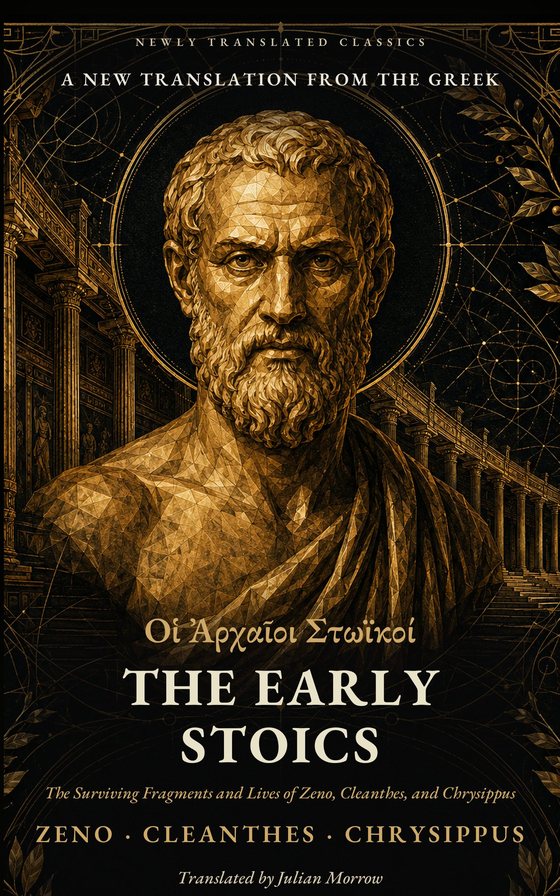
The Early Stoics: Zeno, Cleanthes and Chrysippus
Translated by Owen Halloway