Lucilius Press › Reading guides
Which translation of the Nicomachean Ethics should you read?
If you are studying it closely, a translation with notes, such as Robert Bartlett and Susan Collins's, will serve you well. W. D. Ross's older version is free and widely reprinted, in formal early twentieth-century English. If you want to read Aristotle straight through in plain modern English, the Lucilius Press edition is written for that.
The main versions
W. D. Ross (Oxford, 1908; revised 1925). Public domain in many places and often reprinted. Formal, older English.
Terence Irwin (Hackett, 1985; second edition 1999). Close to the Greek, with notes and a glossary.
Roger Crisp (Cambridge University Press, 2000). A clear modern translation.
Robert C. Bartlett and Susan D. Collins (University of Chicago Press, 2011). Very literal, with notes and an essay.
The Lucilius Press edition
Nicomachean Ethics is a modern plain-English translation of all ten books, made from the Greek, with a short preface for first-time readers and the standard Bekker numbers in each section heading so you can follow along in class. Here is the opening.
Every craft and every methodical pursuit, and so too every action and every choice, appears to be reaching for some good. So it has been well said that the good is what everything reaches toward.
There appears to be a difference, though, among ends. Some ends are activities themselves; others are products beyond the activities. Wherever there are ends apart from the actions, the products are by nature better than the activities.
From Nicomachean Ethics, translated by Owen Halloway, Lucilius Press. Book One, chapter 1. Free sample, reproduced from the book.
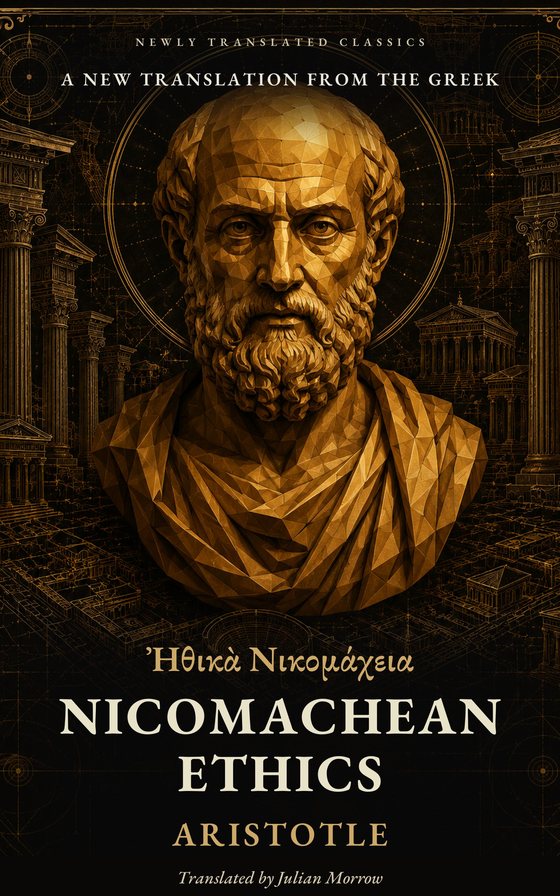
Nicomachean Ethics
Translated by Owen Halloway